At Flip Education, the AI product for lesson planning that I co-founded and ran with one other person and a team of AI agents, we launched in 18 countries with no localisation team. I'd spent six years selling localisation the old way, so I knew what this used to cost. Localisation is largely solved now, and that changes what a leader's job is.
Localisation · Flip Education · Feb to Sep 2026
All work- $40 to $75in AI model fees, before any human review, to translate 100,000 words into 10 languages, against about $77,000 to $93,000 at 2026 agency prices.
- 8 daysfrom the English product to all 11 language versions live, where software makers once shipped languages a month or two after English.
- 18 countriesserved in 11 language versions from the first weeks, with no localisation team and no agency
Why it matters more than ever
Fast-forward to today. Localisation is largely solved, so language no longer slows a launch or eats its return, and a company can afford to think about any market that looks attractive. So localisation matters more than ever, and the job left for a leader is governance, making every language a first-class concern in every part of the business from the first days. At Flip Education, that concern covered the whole operation. The product itself in every language version. Pages on each country's official curriculum, written by AI in that country's language and checked against what ministries publish. And the parts beyond words, legal differences, what we could and couldn't say to users, school years that differ by country. AI agents did the work under written rules, and people checked where it mattered.
The challenge
Before AI, going into a new market meant a labour-intensive process. Agencies, whole departments, tight schedules. SAP ran an internal localisation team of over 250 people. Microsoft once shipped language versions a month or two after English. I saw companies decide the return wasn't there and skip markets entirely. Machine translation helped, but it didn't remove the people, so the cost stayed.
Human decisions
-
Could
A language agency, a native reviewer for every language, or English only first.
ChoseEvery language version live as soon as the first language after English was right, with localisation written into the AI agents' rules.
BecauseOur users are teachers in public education systems, and teachers work in their own language every day. The product had to feel native from day one.
Localisation as a first-class citizen
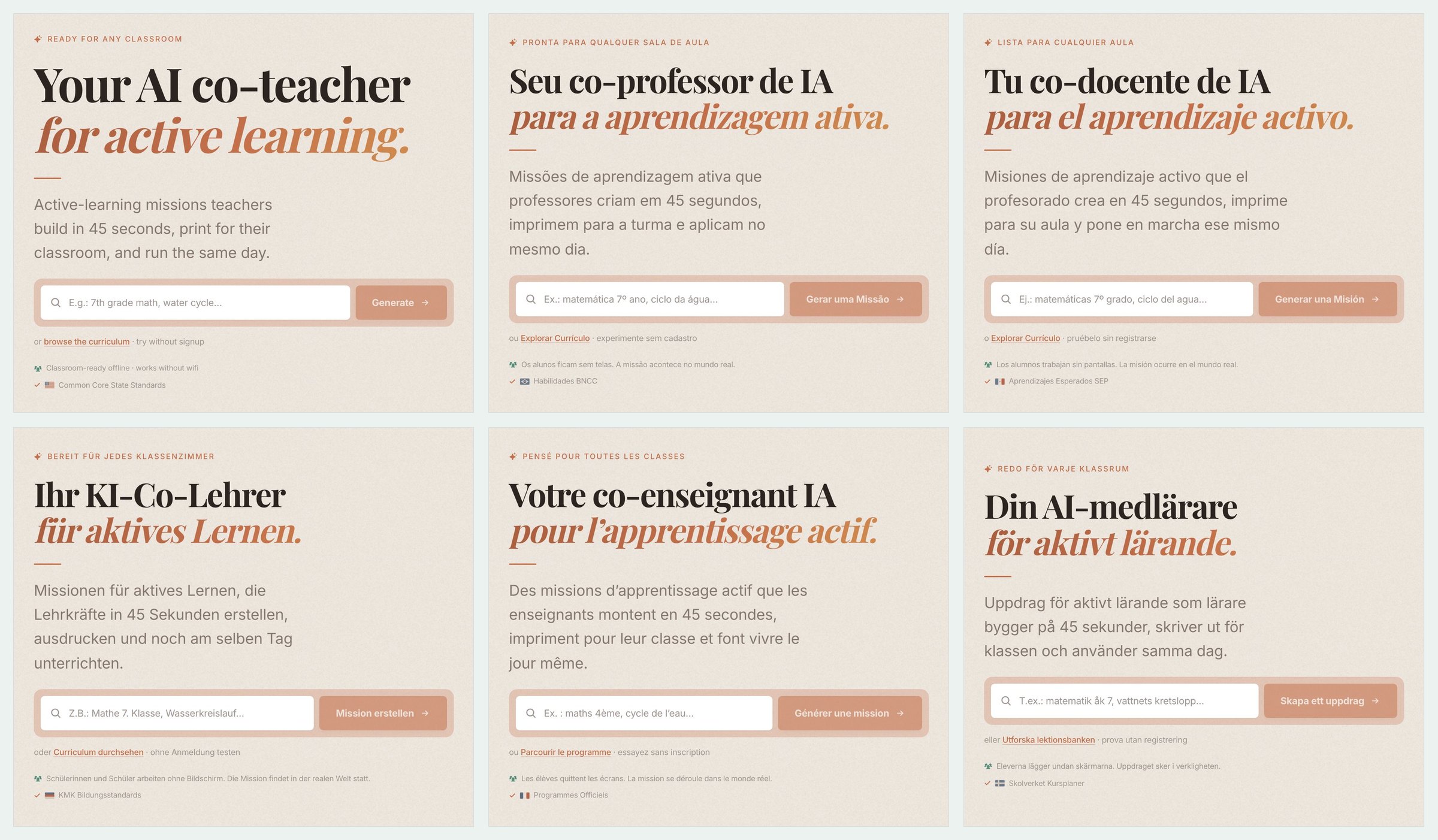
Early on we built localisation into the written rules the AI agents follow. Every plan an agent wrote before building anything had to state what changed in each language version, or why one was left out, so leaving a language out was a stated choice. AI agents built each version, the product's text, marketing pages adapted to each culture, and the curriculum pages, the work that once took agencies and whole departments. Before release, automatic checks sampled pages in the other languages for leftover English. I tested the product myself in the languages I speak, clicking through everything the way a user would. What I found became fixes for the other languages too, and rules the agents followed from then on, so each round made the process stronger. Native speakers reviewed only the business-critical pieces, because reviewing every word would have brought back the agency cost, so review went where a mistake would cost most.
Me and AI agents
We wrote localisation into the agents' rules
So no language was left out without a reason.
Claude Code
AI agents
AI agents built each language version
The product and each country's curriculum pages, with no agency.
Claude CodeGeminiscripts
Automatic checks
Checks looked at a sample of pages in other languages
This came before release, so a slip could be found before users saw it.
Geminiscripts
A version went live
Me
I used the product as a user would, in English, Portuguese and Spanish
Me and AI agents
We corrected each mistake we found and made it a rule or a check
So a known mistake could be caught before it happened again.
Back into the rules
A native speaker
Business-critical pieces went to a native speaker
My call
Every language live in eight days
The product started in English in February, and the first language after English followed four days later. Under four days after that, every language version was up. Soon Google showed the curriculum pages in every country, and users arrived through them.
Where people in the market still win
Research and AI get you most of the way there. I would say it covers about 85%, and the remaining 15% lies with people in the market, what they hear, their deep knowledge of it. The research points the same way. In the yearly research contest for machine translation, AI now matches people for large languages but still clearly loses for small ones, like Egyptian Arabic and Icelandic. So the cost and time that kept companies out of foreign markets have mostly gone, but local judgment hasn't.
What I would keep
I would keep localisation as a first-class concern in the agents' rules from the first days. That part was right. I would change when we tightened the rules, and do it earlier, before mistakes showed us where they were needed.
What I'd tell the team doing this
Test the product the way your users experience it, in a language you can judge. You won't always be able to, because you won't be a native speaker of every language, so human input stays valuable even though the running cost has collapsed. Most of the work is now fast and cheap, and it can be done at high quality. The last part still needs people in the market.
Sources
Receipts. First second language live in February 2026, the agents' rules two days later, all 11 versions and 18 countries within the same week. Built with AI coding agents on Anthropic's Claude models (Opus 4.6 and Sonnet 4.6); the first German pass used Google's Gemini 3 Flash (preview). Translation results from WMT24 and WMT25, where AI models matched or beat human translation in most language pairs tested.
- $40 to $75: Model fees at the list prices of Anthropic's top model, human review not included. Agency side: Alconost's list of rough industry averages, April 2026: $93,000 for human translation, $77,000 for machine translation with a human editor. An illustrative job, not Flip Education's own volume.
- 8 days: Flip Education's code history, February 2026. The before: Microsoft, 2022, and Visual Studio 2008, whose nine main languages shipped a month or two after English.
- 18 countries: 11 language versions: 8 languages, with regional variants of Portuguese, Spanish and English. Flip Education's code history, February 2026.