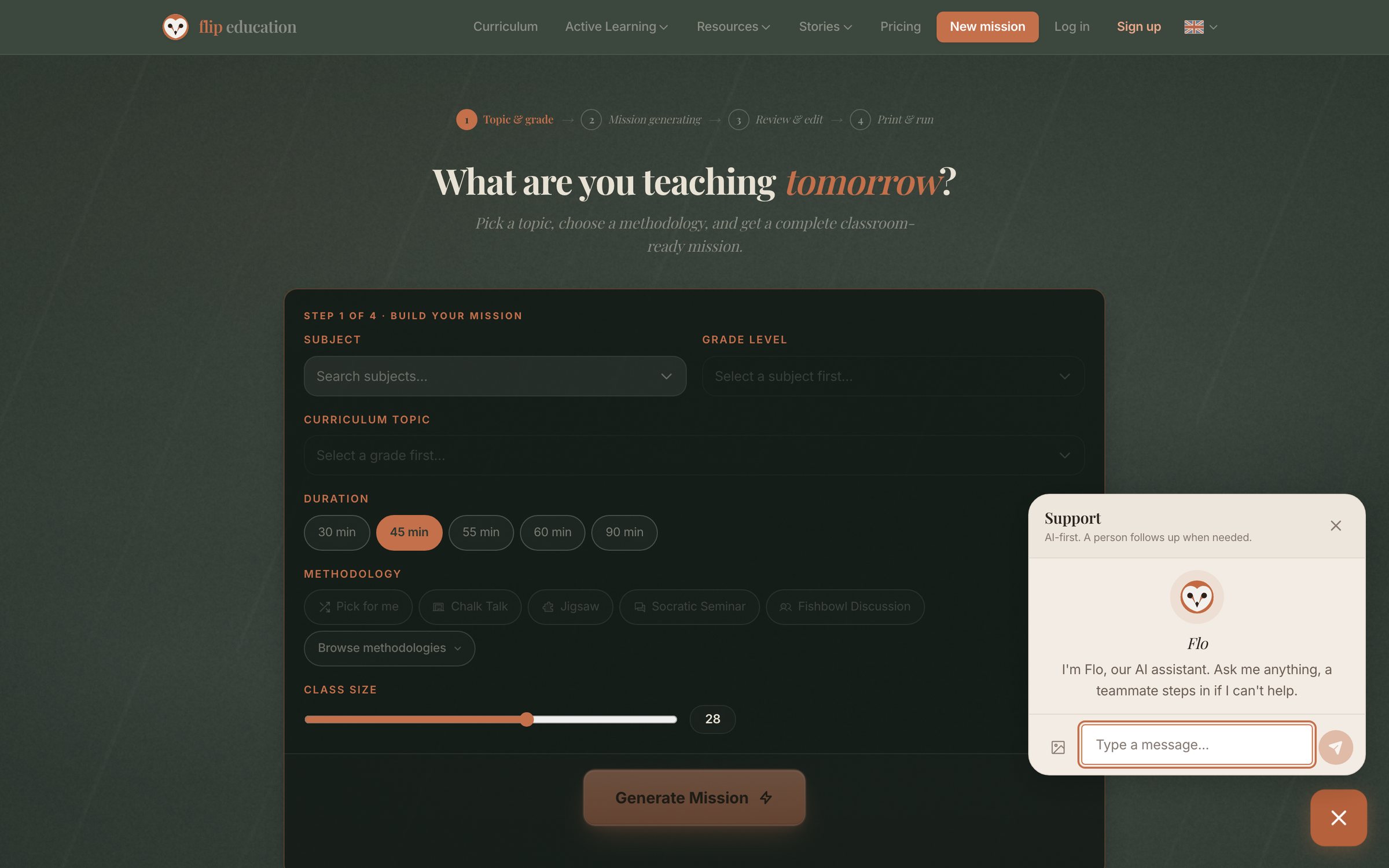
Flo is the support assistant inside Flip Education, the AI co-teacher for lesson planning that I co-founded and ran with one other person and a team of AI agents. It's a chat window on every page, and it answers users at once, at any hour, in their language. We never hired anyone for support. Flo resolved 80% of conversations, counted the way Intercom counts resolutions for Fin, its own AI support agent. The model behind Flo is a ready-made one, so that result came from the context, the process and the tools around it.
Customer support · Flip Education · Apr–Aug 2026
All work- 80%of conversations resolved by Flo, counted the way Intercom counts for Fin, its AI support agent, above Fin's published 76%
- 11 languagesFlo answered in, at any hour, across 18 countries, with no support hire ever needed
- about 8.5 centsin AI model charges per resolved conversation, where Fin starts at $0.99
Why the resolution rate is the business
Any software company that serves users in many languages faces the same arithmetic. It needs a high resolution rate, because whatever the AI can't resolve needs a person who can answer in the user's language. That's either someone who speaks it or, now that translation is good, an English-speaking team replying later rather than live. So the share of conversations the AI resolves on its own decides how many people a company needs behind it. That share isn't set by the model, which anyone can buy. It is set by what is built around it, what the assistant knows, what it may promise, who sits behind it, and what happens to each failure.
The challenge
Two of us ran Flip Education, and nobody was hired for support. In my previous role I managed a customer support team, and we used Fin, the AI support agent made by Intercom. It was a good tool, but operating it was still complex with a small team, because we read messages one by one to find what to improve, turned that into the bot's settings, and wrote help articles by hand. That was just before AI agents could do much of this work. So I wanted to see how much of running a good support assistant AI agents could carry, answering users and writing and shipping the fixes, with me deciding what to fix.
Human decisions
-
Could
For support there were three options. PostHog is the analytics product we already used to see what users did, and it offers a ready-made chat window. Buy a finished support bot like the one I had run. Use PostHog's ready-made chat window. Or build our own.
ChoseWe built our own assistant. For the conversations we used PostHog's new team inbox, an early version that was free at the time. Everything else was built from scratch.
BecauseBuilding meant the assistant could share one source of data with the product's analytics, so it could see what each user did. The cost was real. We depended on an early product that was missing pieces, and we had to work around them.
One assistant, human limits
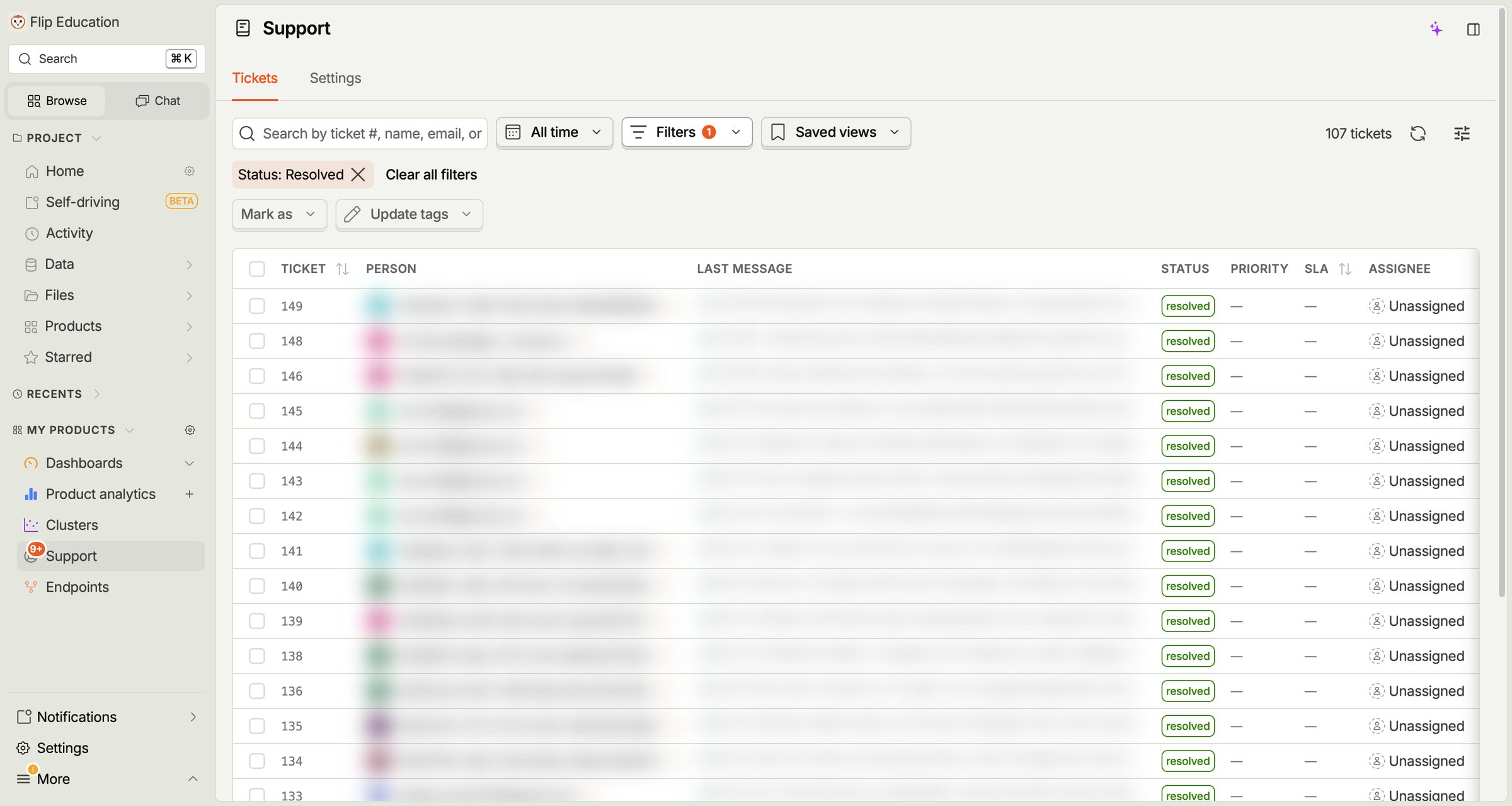
A user writes in the chat window, and Flo reads it with what that signed-in user just did, from pages used to whether they started to pay. Flo also sees their country and the real topics of that country's curriculum, so it never asks for what the account already says. Plans, prices and features come from the product's own code, so they can't drift. Flo answers at once, in the user's language. Flo never promises deadlines or new features, and never claims to do something it can't do, rules we wrote after public failures of other companies' support bots. Every conversation also lands in the team inbox, where a person can reply. When a person joins, Flo goes quiet. Hard questions still reach a person.
Two checkers, plain scripts with no AI, read the conversations afterwards, one for wrong facts, one for unanswered users, so nothing depended on a user complaining. I decided what to fix, and AI agents shipped each change. Every change must pass the tests, and the facts must match the code, before it can go live. A fixed failure stayed fixed, and three times a fix was live for every user before our reply had reached them to say so. Twice, that was about an hour after they first wrote.
A user writes in the chat window
So they ask without leaving the page they're on
What the user just did
PostHog
Flo's facts
scripts
Flo's rules
Flo reads the message together with these
So the answer is about this user, not a general rule
Flo answers at once, in the user's language
So the first answer never waits for someone who speaks the language
Claude
It ends on Flo's answer
A person joins and Flo goes quiet
So a person is needed only where Flo can't resolve it
The team inbox
So every conversation can be read afterwards
PostHog
Two checkers looked through the conversations
For wrong facts
For users left with no reply
I decided what to fix
AI agents built each fix
Claude Code
Before any change goes live
So a change that fails is caught before it reaches users
Flo's facts
Flo's rules
Language tests
The product itself
The chats improved Flo
Knowing what the user just did
The way to better answers was context. The example below is a user asking how many lessons they can still make on the free plan, which the product calls Spark and which allows 5 lifetime missions, the product's word for the lessons it generates. Without the user's context, Flo can only give the plan's general rule and send the user to their dashboard for their own number. With context, it already knows the user has generated 2, so it answers with their exact count at once.
Example. Same instructions on both sides.
Without user context
I'm on the free plan, how many lessons can I still make on it?
The Spark (Free) plan gives you 5 lifetime missions total, not per month. I don't have visibility into how many you've already used, so check your dashboard to see your remaining count.
With user context
I'm on the free plan, how many lessons can I still make on it?
You've generated 2 so far, so you've got 3 missions left on Spark (Free), which comes with 5 lifetime missions total.
What broke, and what we made permanent
When Flo met real users, it failed in ways we hadn't foreseen, and every failure led to a lasting fix. In April Flo told a paying user about a "Pro" plan that doesn't exist, and that same evening Flo's facts started being generated from the product's own pricing code, with a first checker reading answers for wrong facts. Later, a user sent seven messages in a few minutes and got no reply, which that checker couldn't see because it only judged answers that existed, so a second checker, an hourly watch for unanswered users, followed. An Italian user got a reply in Spanish, one of several wrong-language answers that led to a test set of real user sentences, which every change to the language check must pass. The Hindi case is below.
A language we didn't serve
In August a user wrote five messages in Hindi, typed in Latin letters. Flo answered all five in English, most with the same standard line. I saw the ticket about ten minutes later. The real gap was that Hindi wasn't one of the 11 languages Flo was set up for. We also tested a ready-made language detector and rejected it, because it read a plain English support question as Venetian, a language spoken in parts of Italy. So my decision was that Flo answers in the user's language, even one the product doesn't serve, and says in that language that the lessons come in the 11 languages Flip Education serves. The fix was live for every user about two and a half hours later, with no extra spend.
What I would keep, what I would change
What I'd keep is the user's context on every message, and Flo's facts generated from the product's own code, so they can't drift. The speed of fixing came from AI agents that wrote and shipped the code changes, with access to the product's code, and users' reports often became product changes within days. What I'd change is measurement. Users could never rate an answer, so afterwards I brought in two AI judges. They read every conversation from April to September.
Intercom's way of counting is that a conversation is resolved when it ends on the AI's answer and no person is needed. Counted that way, Flo resolved 80%. Intercom publishes 76% for Fin, its own AI support agent, so Flo sits above Fin.
What it cost
The first version took about three and a half hours of my own time, over one evening and the next day, and it went live the second day. Reviewing and improving it afterwards took about 3 to 4 more hours. All the coding work was done with Claude Code, an AI agent that writes code, on a flat-fee plan, so it added no metered spend. Flo's AI model charges work out at about 8.5 cents per resolved conversation. Intercom's price list starts at $0.99 for each conversation Fin resolves. On Intercom's own plans, the seats, a monthly fee for each person on the team who uses the inbox, come on top of that. Both figures leave something out. Flo's leaves out my build time. Fin's leaves out the seats.
What it could mean for a software company
Here's the estimate. It uses Flo's 80%, counted the way Intercom counts resolutions for Fin. Say a company gets 1,000 conversations a month. At Flo's rate, 200 are left for people, so the AI resolves 800. Resolving them costs about $6,400 a month with people, at the average cost per conversation from a Gartner survey of customer service leaders. With Fin at its list price, about $790. Flo's AI model charges come to about $68. There's also speed for the user. Companies without AI took 41 minutes on average to respond in real-time conversations, according to the customer service benchmark from Freshworks. Flo answers at once, at any hour.
What's next
The next step is one model running the whole improvement process. A more capable model could run this process on its own. It could review every conversation, or a sample, or only the ones that weren't resolved, decide what went wrong, improve Flo, put the change live and measure the result. The pieces all exist now.
When to build your own
If nobody on your team can read and change the code quickly, a bought bot is safer. Test any bought part on your own customers' messages before you adopt it, because the ready-made language detector we tested failed on real messages in ways no demo showed.
Sources
Receipts. PostHog Conversations, the team inbox, an early version that was free at the time. PostHog analytics, the record of what each user did in the product. Claude Sonnet 4, the AI model writing the answers, at launch in April 2026, Claude Sonnet 5 from August 2026. All code written and fixed with Claude Code, an AI agent that writes code. The cost was measured from the AI account's spend readings and the session logs. In my previous role the bought bot was Intercom's Fin. Intercom published Fin's resolution average of 76%, March 2026. The estimate uses Gartner's 2019 poll of customer service leaders, Freshworks' 2025 customer service benchmark, and Intercom's price list read in September 2026. The 11 language versions and the 18 countries are the product's own lists.
- 80%: Flo records and AI judge review, September 2026.
- 11 languages: Flo's language settings and message log, April to August 2026. The 11 and the 18 are the product's own lists of language versions and countries.
- about 8.5 cents: Flo's figure from the AI account's spend readings, Fin's price from Intercom's price list, September 2026.