Flip Education is an AI co-teacher that helps teachers plan lessons. I co-founded it and ran it with one other person and a team of AI agents. We had no PR team, so I built a digital PR desk run by agents, working for earned links. An earned link is a link another site gives because an editor chose to, not a bought link and not a trade. 143 editors wrote back after my desk pitched publications across Europe and Latin America.
PR · Flip Education · Feb–Aug 2026
All work- 143editors wrote back, 8.1% of 1,774 publications pitched in seven languages, work that by hand would have needed several agencies
- 1 to 2 hoursa week of my time, against published agency prices of $5,000 to $15,000 a month
Why I trusted agents with PR
I'd say what trusted sites say about a company counts more now, not less. Search engines look at it, and so do the AI tools people ask for answers, so being present on third-party sites matters more than ever. The slow part of PR is the research and the writing for each publication in its own language, and that's work AI agents can now do. So a desk of agents did the job end to end. Checks ran before anything was sent, and three rules of mine sat on top. Pitch only where the readers can use the product today, never pay for a post, never trade links. The agents gave the desk its reach. The checks and my rules decided what could go out, and the calls that could cost money or the site's standing in search stayed with me.
The challenge
We had no PR team and no agency. Bought links were never an option anyway, because they can hurt a site in search and they don't build trust with editors. Agencies price per market, and with seven languages across Europe and Latin America this would have needed several agencies or one very large retainer.
How the desk worked
The agents found publications by motive, such as articles quoting out-of-date statistics, pages with dead links, resource pages, newsletters and outlets ranking for our topics. Sites that charge for posts were blocked here. So each pitch started from something that publication could use, a fresh statistic for an old one, a working link for a dead one.
They researched each publication still online, its readers, its voice, its recent themes and the gap a pitch could fill, then wrote one pitch in its own language.
Before sending, scripts and an AI model checked each pitch for topic fit and for a publication already pitched. A pitch that failed any check wasn't sent.
The first batch sat as drafts in my email. I caught that the drafts described the product too narrowly, so I had every one redone before any were sent, then sent the batch myself. Later waves went through the checks, then out through an email platform loaded by the agents. How the product was described was my call before anything went out in volume.
The agents tracked every thread to a placement or a close. Where a reply asked for payment, or for a trade of links, the call was mine.
The deskClaude CodeCodex
- 1
Publications found by motive
AI agents
 DataForSEOGemini
Sites that charge for posts
No paid posts
- 2
Each outlet researched
AI agents
Gemini
Reader can't use it today
The audience rule
- 3
One pitch per outlet, in its own language
AI agents
Gemini
- 4
Checked before any send
Scripts and an AI model
Duplicate or failed check
- 5
Pitches sent
I sent the first batch myself
AI agents loaded the later waves after the checks
 Instantly
 Smartlead
 The publications
Editors write back
- 6
Each thread tracked to a close
AI agents
SmartleadGmailMy call on payment and link-trade requests
No link trades
Earned links
Human decisions
-
Could
I could have had an AI agent write a setup guide for people to follow, instead of doing the work itself.
ChoseI turned the guide down and had the agents do the whole job themselves.
BecauseA guide still leaves the work on two people's desks.
-
Could
I could have chosen publications by their authority score, the usual measure of how strong a link from a site is.
ChoseI chose the audience rule. Can this outlet's typical reader use the product today? If not, the outlet is out, whatever its score.
BecauseA link from an audience that can't use the product brings no users, so the score doesn't matter.
-
Could
I could have accepted a publisher's request to trade followed links, links that search engines count towards the other site's standing, each site linking to the other.
ChoseI refused it myself, on link-scheme grounds.
BecauseA link trade is a link scheme and can hurt a site in search. The product still went into that company's comparison page, and they later linked to our statistics page in a way search engines count, without being asked.
The work
Evidence
What happened
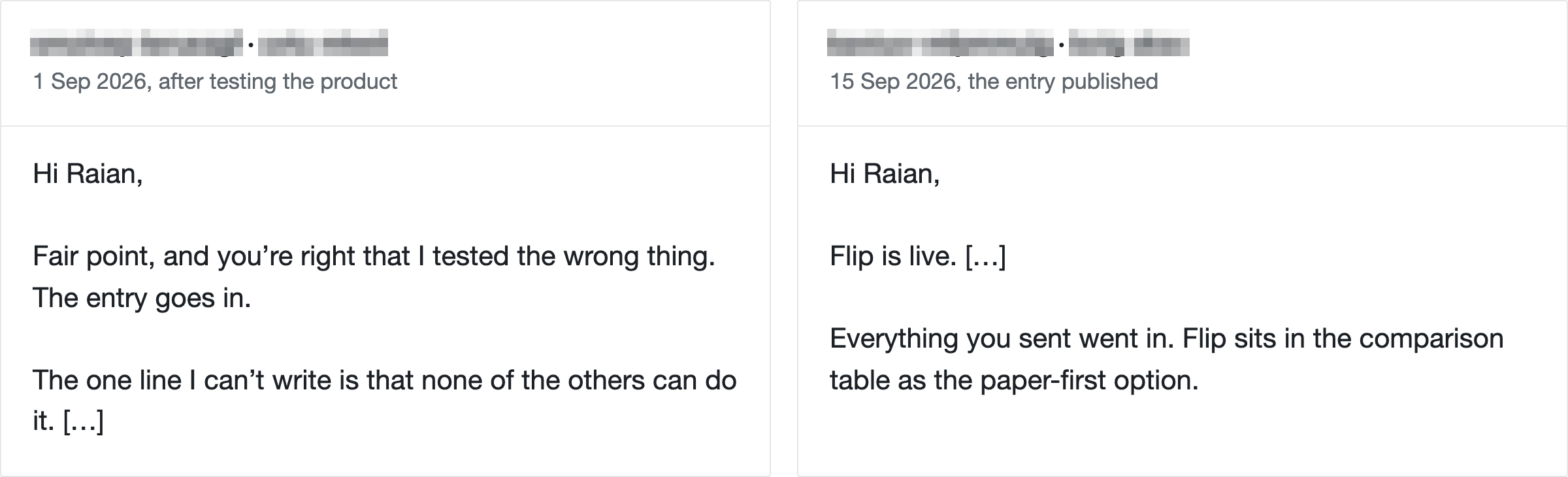
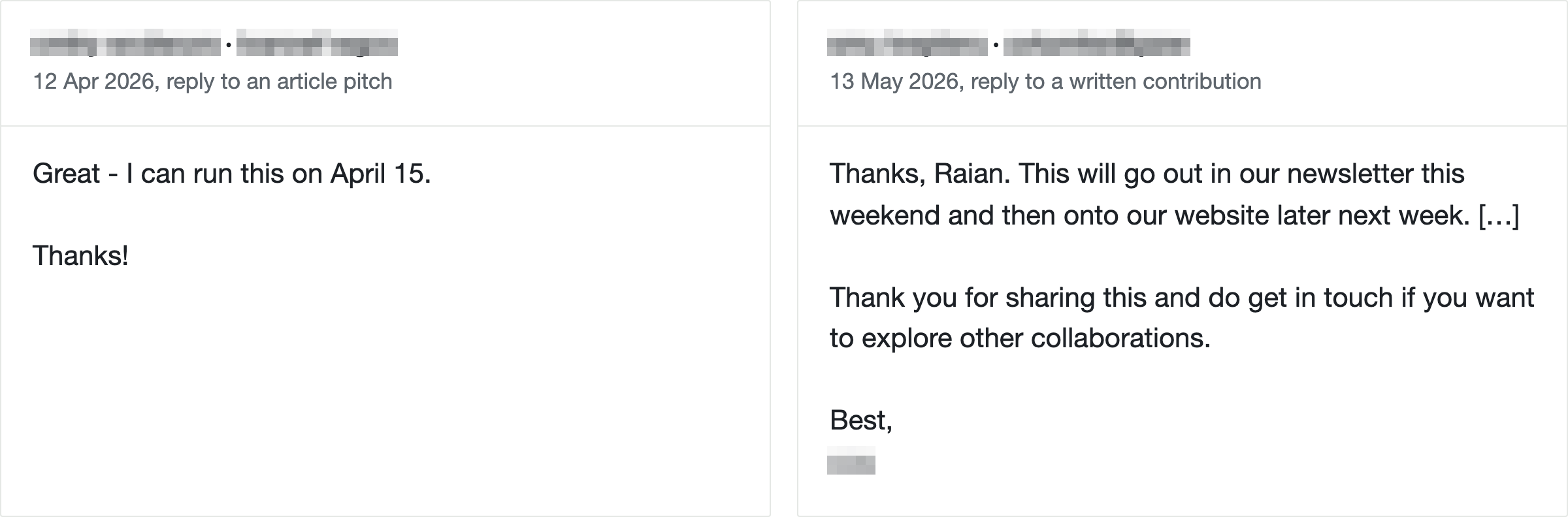
The desk started work one evening in February, when I opened my first working session with the AI agents. Within two hours the first pitches were out. The desk ran in waves after that. It pitched 1,774 publications in seven languages. 143 editors wrote back. The picture below shows two of the acceptance emails.
What it cost
My own time was about 1 to 2 hours a week. Published agency prices put a single-market retainer at about $5,000 to $15,000 a month. One agency says a six-month minimum is typical. Each extra market adds about $2,000 to $5,000 a month by one agency's guide.
What I would keep and change
I'd keep the audience rule and the duplicate check, because pitching the same editor twice makes a reply less likely. I'd write the workflow as fixed steps in software from the start, instead of the agent running it from memory and a written description.
When a team shouldn't do this
A competent digital PR team is still better for the average case, above all in a niche where their connections matter, and for placements in high-visibility publications, which is hard to reproduce even with a system like this. And for a single country, because this desk's advantage was many countries at once, where you would need several agencies. For one country, one agency covers the job.
Sources
Receipts. The AI agents worked in Claude Code and Codex, AI agent tools from Anthropic and OpenAI. Their scripts used Gemini, Google's AI model, to find, research, draft and check. Bulk waves went through a cold-email platform, a tool that sends outreach emails in volume. Search data came from a search-results data service, which returns live search results as data. The reply, pitch and language totals come from the campaign record, May 2026. The 38-day figure comes from published data by a digital PR agency, across 157 campaigns. The agency prices come from published agency pricing pages and guides, 2026.
- 143: The campaign record counted 143 editor replies, May 2026.
- 1 to 2 hours: My estimate of my own time, September 2026.