Flip Education is an AI co-teacher that plans lessons following each country's national curriculum, and I co-founded it and ran it with one other person and a team of AI agents. The website records a share of visits as replayable videos of what users did on screen, but a small team can't watch them, so what users run into goes unseen. Since March, a first version of this system read those recordings' numbers every day and turned what it found into fixes. In September, as the company's advisor, I had AI agents upgrade it so the AI also sees the screens and proves each finding before anything is fixed. The outcome was fixes proven in the code three hours after my first request.
Product · Flip Education · Mar–Sep 2026
All work- 4 fixesin Flip Education's code within about three hours, solving real problems visitors hit that nobody had watched
- under 6 hoursof my working time to upgrade the AI system that reads our session recordings, with no extra AI spend.
One weekly view of what users do
Watching session recordings is one of the main ways product and UX teams find bugs, learn about the user experience and improve the product. The cost is time. Someone has to sit through the videos, note what they see and turn it into tickets. AI can now do this reading. At Flip Education the whole thing runs as one line of work. The recordings the website already collects come in. A free count runs across all of them every week, with no AI, and a short AI step decides how much reading the week deserves. AI then reads the screens of the visits worth reading, and each finding is proven outside the AI, on the live site, in the code and in the data. AI agents that each look after one part of the product fix what is proven, and I make the decisions that are mine.
The challenge
At SEOmonitor, a software company that tracks search rankings, where I worked before, I set out to automate the watching. We had a fairly large user base and wanted the top insights for the product engineering team without spending hundreds of hours watching. Nobody had the hours to watch them, and it still mattered, because the users' experience shows up in sign-ups and subscription income. All we had to work with was telemetry in text form, the list of pages visited and the actions taken inside the app. I tried the best AI agent then available that operates a web browser. It was meant to collect what our recording tool wouldn't export, and even the best models of the time couldn't do it reliably. At Flip Education the same problem came back, and watching the recordings by hand would take many hours a week. There was no staff to hand it to. The product team was me, so it would have eaten into the strategic time I needed for other things.
Numbers, but no screen
The first version at Flip Education ran on the same recording data the website already collected. A separate AI, run on a schedule, read only the numbers behind the recordings and emailed me a summary. It never looked at a screen. About a dozen product fixes in our code history came from that daily summary, and those fixes went live for every user. It showed a user searching the lesson maker for a Year 4 maths topic that the curriculum didn't have, and we added the topic. The recordings confirmed that every sign-up from outside the US was being saved as a US user, which we then fixed.
Better models, a better system
By September the AI models had got a lot better, both at visual understanding and at doing competent coding and reasoning work, so I upgraded the system. And the screens show things the numbers can't, like what a page actually displayed and what the user was trying to do, which means better fixes. PostHog, the analytics product behind our recordings, lets them be exported and read by software.
How a week runs
Before anything ran, I set what a finding is worth to the business and the bar, what the new findings must be worth together before a full review pays off, because the system is judged by what it is worth, not by how many problems it finds. Every week a script counts the signals across all the recordings, with no AI, among them new errors, where people left the lesson maker and what the last release changed. That covers every recording and costs nothing. A short AI step then reads the count and decides on a full review, a small one or none, and writes down why, so the costly reading runs only when it can pay off.
Scripts remove anything a visitor typed before any AI sees a recording, then rebuild each chosen visit into the screens the visitor saw, so the AI sees what the visitor saw, never what they typed. AI analysts write down what went wrong, and an agent that didn't write a finding sets aside the ones already known, reads the code itself and, for anything on the live site, sees the problem happen there, so only new, proven problems reach a fixer. A small proven problem is fixed by the agent running the week and goes out in the normal release, and anything bigger or risky goes to the agent that owns that part of the product, so small problems don't wait and risky changes stay with their owner. I hear about it only when a decision is mine, so my time goes to the decisions, not to reading reports.
Before anything ran, I set what counts, and the bar
So the system is judged by what its findings are worth to the business
Nothing typed may reach the AI
Every week, a script counts the signals, with no AI
So the count covers every recording, at no AI cost
PostHog
A short AI step decides how much reading the week deserves
So the costly reading runs only when it can pay off
Claude Code
No review, when there's too little to read
Scripts remove anything typed and rebuild each visit as screens
So the AI sees what the user saw, never what they typed
PostHog
Bots and idle tabs left out
AI analysts write down what went wrong, and other agents try to disprove it
So only new problems that matter reach a fixer
Claude CodeAnalytics method
Already known, set aside
The agent running the week reads the code and, for anything on the live site, sees it there
No proof, no fix
So a wrong explanation can't become a wrong fix
Claude Code
If not proven, a report to the owner, never a fix
A small problem is fixed by the agent running the week
It goes out in the normal release. Small problems don't wait.
Anything bigger or risky goes to the agent that owns that part of the product
So risky changes stay with their owner
Only a decision that is mine comes to me
So my time goes to the decisions
A fair test, then proof
On the first evening of the upgrade, I tested whether reading the screens adds enough to be worth a weekly run. The bar was that the new findings together had to touch at least a tenth of a week's sign-ups, first lessons (the first lesson a new user makes) or signs of lesson quality. We counted lesson quality in lessons a user printed, since printing means the lesson goes to class, and users who made a second lesson within a week. Three AI analysts, the same model each time, read the same recordings, each given more to go on than the one before, and only the last also saw the pictures. The first analyst, the one reading only the numbers, already found most of the problems. The pictures added the ones numbers can't show, like what the lesson page looked like. Then 14 findings were checked on the live site, in the code and in the data. What the AI saw was fully or partly right every time, never wrong. Why it happened was fully right in only 5 of 14. A separate checking AI, a different model told to disprove the findings, had approved all 14, including the explanations that were wrong or only partly right. So in this test, a checking AI wasn't enough. Since then, every finding is checked in the code before anyone is asked to fix it. The new findings were real, but together they came in under the bar, so the test recommended running it only when needed, after a release or for a named question.
What the system caught
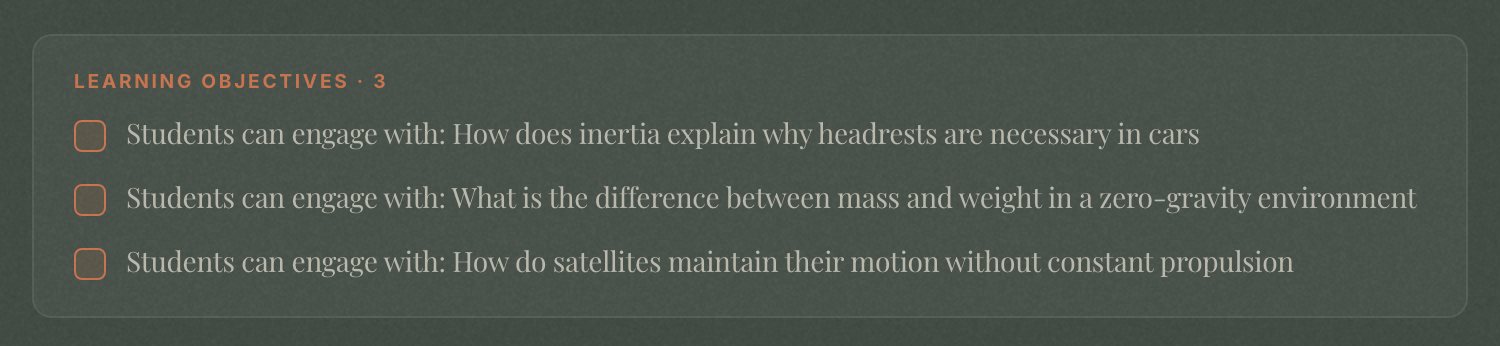
On the lesson page, the AI inside our product writes measurable learning objectives for every lesson, and those objectives were written correctly. The problem was the page itself. It looked for them in the wrong place, so it showed filler lines where the real objectives belonged. Only the analyst with the pictures noticed. The picture below shows what users saw. The code check found the cause, and the fix was one line.
On the sign-up box, from mid-September a visitor without an account who pressed Generate first met a sign-up box. Generate is the button that creates a lesson. The box had no close button. The numbers showed visitors leaving it without signing up, and they couldn't show how. The recordings answered it the same evening. Every time, the mouse moved up to the browser's Back button. Checking that path on the live site found a crash behind it. After going Back, the page froze and the visitor couldn't continue. One fix repaired the crash itself, so the next page change works again after going Back. The other shows the sign-up box again at once when the visitor presses Generate a second time.
On the curriculum pages, visitors clicked links again and again and nothing happened. A scripted browser, software that clicks through the site like a visitor, showed why. A loop, code that kept running over and over in the background of those pages, blocked every link, and switching it off made the same click work at once. The recordings showed what the loop had been costing visitors, people clicking again and again with nothing happening. The loop itself was already gone, removed by another agent to make the pages faster, without knowing it blocked clicks.
That first test, run the same evening I started, led to four fixes in the code. Three came from the catches above, the learning objectives on the lesson page and the sign-up box problems. The fourth was a smaller wording fix. Every finding, fixed that evening or not, went into the plan of the agent that owns that screen.
Human decisions
-
Could
I could have used PostHog's own recording AI, which our plan already included. It turns each recording into a short sped-up video and sends it, with the recorded events, to an outside AI model, which notes what the user did.
ChoseI chose to build our own pipeline and not use it.
BecauseOur own pipeline works inside our code, with our business rules, and can check each finding on the live site and in the data. An outside AI sees only the video and the recorded events.
-
Could
I could have trusted the AI analyst's findings, since the checking AI had approved all 14.
ChoseI chose to prove each finding on the live site, in the code and in the data before any fix.
BecauseIn the test, the checking AI approved explanations that were wrong or only partly right, so an unproven finding could lead us to fix the wrong thing.
-
Could
I could have run it only when needed, after a release or for a named question, as the test recommended.
ChoseI chose to run a small counting step every week, which costs nothing extra. A full review runs only when the count suggests the new findings could clear the bar.
BecauseThe team was very small, and a review that depends on someone remembering to run it stops happening, so it had to run on its own. A small deciding step means a full review runs only when it's worth it, at no extra AI cost on our flat-fee plan. I wanted small proven problems fixed straight away rather than left waiting.
What changed for the business
About 25 hours passed from my first request to the version of the system I approved for production. I spent under 6 of those hours working on it myself. Those four fixes have since gone out to users through the company's normal release. The first full run of the upgraded system, after the test, found its problems, checked them in the code and sized them in 57 minutes.
What I'd tell a product team
AI that reads your session recordings gives a small team a direct view of what users actually do and what they want. Aim it at a named question, or run it after a release. A weekly run is worth it only if a cheap first step decides whether anything new justifies a full review; without that step, stay with the named question or the release. In my test, reading recordings with no question in mind found real but small problems. You need recordings you can export, typed text removed before any AI reads them, and proof of each finding before anyone fixes it.
Sources
Receipts. PostHog, the analytics product we use, supplied the session recordings and event data. Claude Code, Anthropic's coding tool, ran Claude Opus 5.5, Anthropic's AI model, for the analysts, the code checks and the sizing. Claude Sonnet, a lighter Anthropic model, was the checking AI told to disprove findings in the first test. A scripted browser, Playwright, ran the live-site checks. Scripts removed typed text and blocked any recording that still held some, then rebuilt each visit into screens. The Mac's built-in scheduler, launchd, runs the weekly run; a team without a Mac that stays switched on could run the same weekly job on Claude Managed Agents, Anthropic's hosted service for running agents. The first version ran March to July 2026 on Claude Opus 4.6, later 4.8, and read only recording lists and event logs. The upgrade was built in September 2026, and the weekly run is scheduled every Thursday. The test and the first full run had no metered spend. They used about 3.7 million tokens, the units AI models are billed in, on a flat-fee Claude plan.
- 4 fixes: From the product's code history, measured from my first request, September 2026.
- under 6 hours: From my tracked build time, September 2026.